Walk into any gallery and you will probably spend about eight seconds in front of each painting before moving on. Eight seconds is roughly how long it takes to read a pub menu. It feels like enough. It almost never is.
What Raking Light Shows You
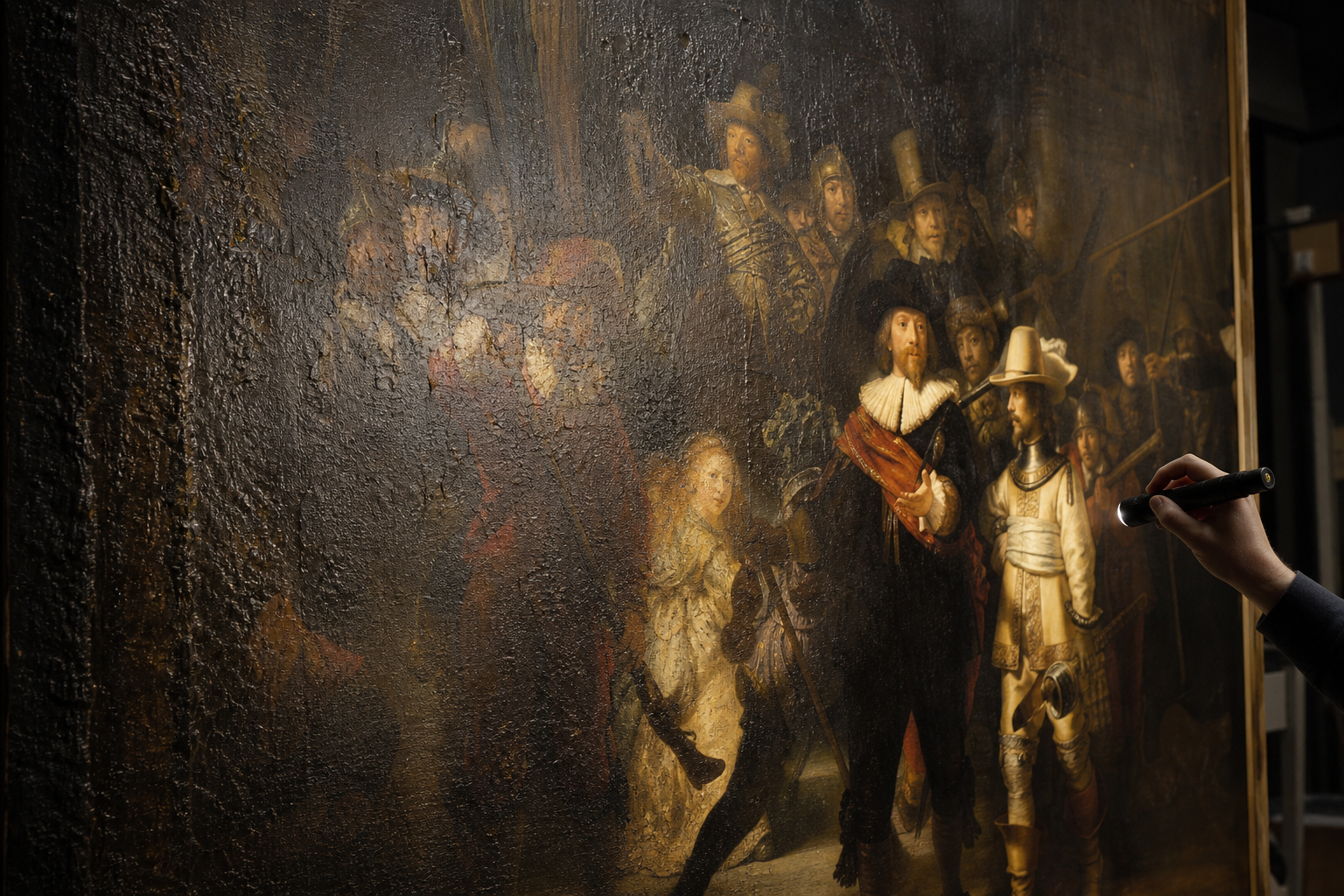
There's a trick that restorers and conservators use when they're examining a painting for the first time: they look at it under raking light, which means shining a beam across the surface at a very low angle, almost parallel to the canvas. Do this and the painting stops being a picture and becomes a landscape. Every bump and ridge in the paint throws a tiny shadow. You can suddenly see the whole physical history of the thing – where the artist scraped back and started again, where a thick brushstroke sits on top of a totally different composition underneath, where someone (maybe the artist, maybe not) came along decades later and quietly repainted a section they didn't like.
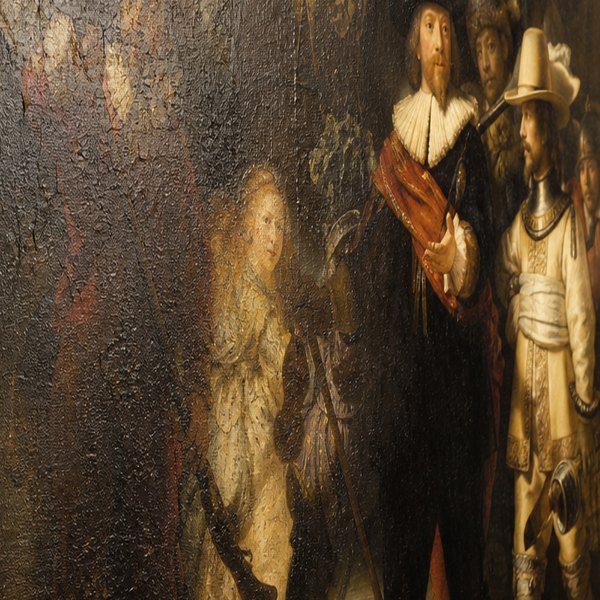
That last part happens more than you'd think.
The Night Watch You Know Is a Crop
When conservators X-rayed Rembrandt's "The Night Watch" they found that at some point in its life the canvas had been cut down on all four sides – most dramatically on the left, where an entire group of figures simply vanished. The painting you have spent your whole life seeing, the one on every Dutch tourism poster, is not the painting Rembrandt finished. It's a crop. The full composition had a different balance, a different mood, a different story – and someone, at some point, decided it was too big for a doorway or a wall and trimmed it without much ceremony, the same way you might crop a photo on your phone.
This is actually fairly normal in the history of painting. Canvases got cut to fit new frames. Sections got rolled up and stored separately. Patrons changed their minds about what they'd commissioned. Jan van Eyck's "The Arnolfini Portrait" still has its original frame, which is nearly miraculous – most paintings have been reframed so many times that the edges of the original composition are long gone.
The Paintings Waiting Underneath
Underneath paintings, meanwhile, whole other paintings are waiting. Infrared reflectography – a technique that sees through paint layers the way an airport scanner sees through a bag – revealed that underneath Raphael's "La Belle Jardinière" there's a completely different arrangement of the figures. The Christ child was originally sketched in a different position, Mary's head was turned another way. The painting we know is Raphael's third or fourth idea for the same composition, all compressed into a single surface a few millimetres thick.
There's something genuinely strange about standing in front of a painting once you know this. The surface you're looking at is the newest layer of a conversation that might span centuries: the artist's original vision, the changes made halfway through, the restoration work done in 1820 by someone who thought they were helping, the cleaning in 1965 that took off a glaze the artist had applied on purpose. You are looking at a palimpsest – a document written over and over on the same sheet.
(For something completely different but worth a look: Your School Website Is Lying About You (And Parents Can Tell) is a sharp little read about how schools present themselves online.)
Can you see these surface effects in a gallery yourself?
None of this means you need a degree in conservation to enjoy a painting. But it does mean that the eight-second glance is selling you short. Next time you're in a gallery, stand close enough to see the texture of the brushwork – close enough that a guard gives you a slightly anxious look. Look at the edges of the canvas for signs of where the composition was altered, and watch for passages that seem slightly flatter than the rest, slightly less alive: those are often repairs. The painting is trying to tell you its whole biography. Most people just never give it the chance.
Questions this raises
- What is a pentimento and how is one spotted?
- Do galleries tell visitors when a painting was reworked?
- How does X-ray imaging differ from raking light?