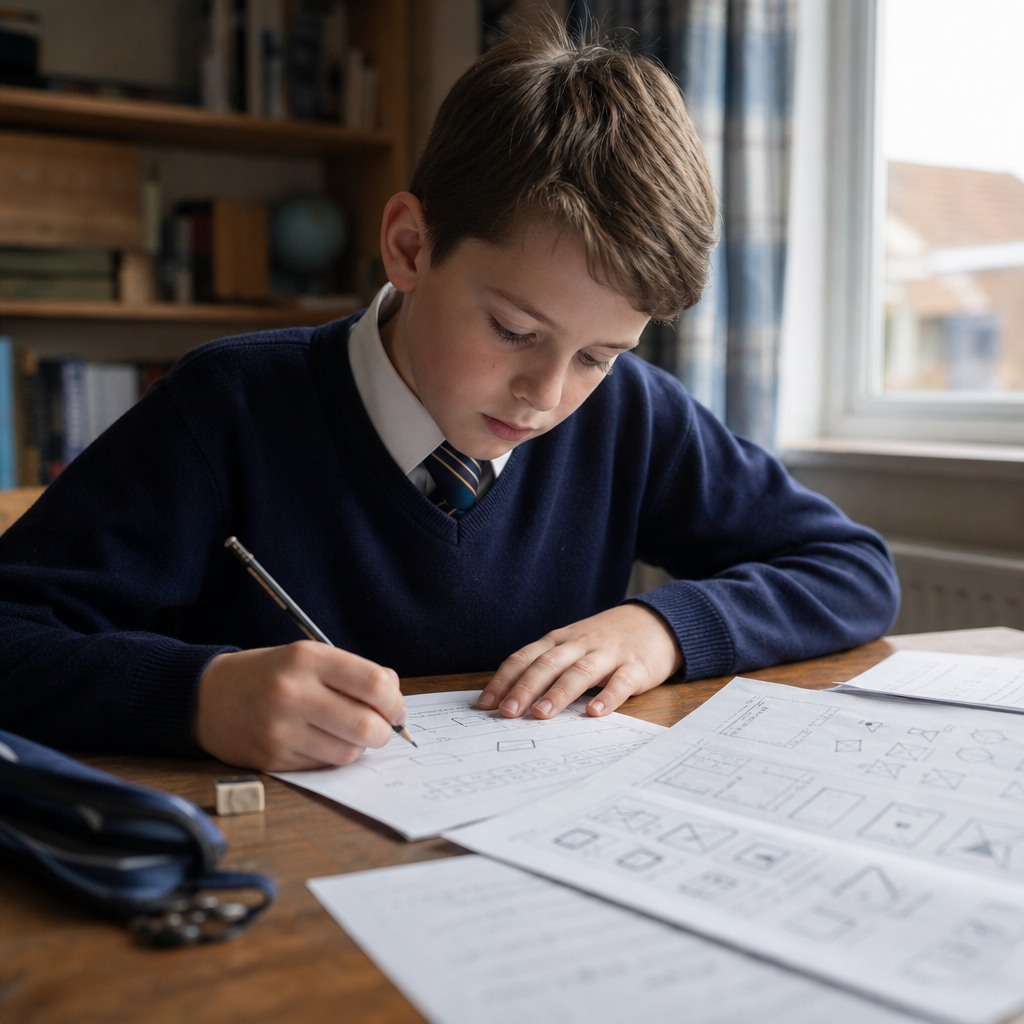
Somewhere in Britain, right now, there is almost certainly a primary school child being quietly coached through practice papers. Verbal reasoning. Non-verbal reasoning. The shapes, the sequences, the odd-one-out. Their parents know the stakes. In a handful of counties that never abolished it, the eleven-plus still sorts eleven-year-olds into grammar schools or secondary moderns – or, as they tend to be called these days, "other schools", as if not naming the consolation prize softens the blow.
But the really interesting thing isn't that the test still exists in places. It's what the test was always built on. And how a piece of genuinely progressive legislation quietly smuggled in one of the stranger ideas in the history of education.
The Act That Was Supposed to Fix Everything
The 1944 Butler Education Act is rightly celebrated. Before it, secondary education in Britain was mostly something you paid for. Clement Attlee's generation had grown up in a system where the shape of your life was largely set before you were old enough to understand why. The Butler Act changed that: free secondary education for every child, funded by the state, guaranteed. It was a serious moral achievement.
And then someone had to decide what to do with all those children.
The answer the Act baked in was a tripartite system: grammar schools for the academic, technical schools for the practically clever (these largely never got built, as it turned out), and secondary modern schools for everyone else. To route children into the right channel, you needed a test. You needed it at eleven, because that was when children transferred. And so the eleven-plus was born, not as the point of the policy, but as the administrative mechanism for carrying it out.
The Machine and Its Hidden Blueprint
Here is where it gets genuinely strange. The eleven-plus wasn't designed to measure what children had learned. It was designed to measure what its architects called "general intelligence" – something they believed was innate, fixed at birth, and largely unaffected by teaching. The psychologists behind it worked in a tradition that ran back through Francis Galton's Victorian obsession with measuring human capacity. They held that you could identify this natural ability with the right questions, even in a child who'd had almost no schooling.
The awkward consequence of this theory was that the expected distribution of results looked remarkably like the existing class structure. Roughly a quarter of children were deemed grammar-school material. The rest were not. This wasn't presented as a social judgment. It was presented as a scientific one, the test simply reading what nature had already written.
You can see the appeal of that framing to anyone designing a system at scale. If intelligence is fixed and measurable, you only need one morning to find out where a child belongs, and then you can build the right kind of school around them. The grammar school got the O-levels and the university track. The secondary modern got a curriculum oriented toward "practical" life – which, in 1944, largely meant factory work for boys and domestic service for girls.
The Architecture of Low Expectations
What the tripartite system actually built was a set of institutions with different ceilings. Not just different resources or different teachers, but different assumptions about what the children inside them were capable of. Once you had sorted a child at eleven, the system around them was calibrated to confirm the prediction. Secondary modern schools often couldn't even enter pupils for O-levels until the late 1950s. The test didn't just assess the child. It assigned them a future and then built walls around it.
Comprehensive schools, introduced through the 1960s and largely completed by the 1970s, were the political response to this. They scrapped the sorting mechanism, put all children in the same building, and tried – with varying success and very uneven funding – to let the architecture stop deciding things in advance. There's a discussion of how location and prestige still shape educational value in ways that are surprisingly similar to the art market – a postcode changes the price of everything.
What the Test Was Really Testing
The psychologists were wrong about fixed intelligence. That's the plain scientific verdict, and it hardened into consensus decades ago. Coaching works – obviously, visibly, measurably – which is not something that should be possible if you're measuring something innate. What the eleven-plus actually tested was a combination of preparation, familiarity with the question format, language exposure at home, and the kind of abstract reasoning that middle-class children encountered more often simply by being around more books and more adults who talked in a particular way.
Which means the sorting machine wasn't neutral. It was reading the child's background and calling it their ceiling. The Butler Act wanted to democratise British education. What it accidentally industrialised was a Victorian theory of human worth, wrapped in the authority of science, administered on a Tuesday morning before the register was even called.