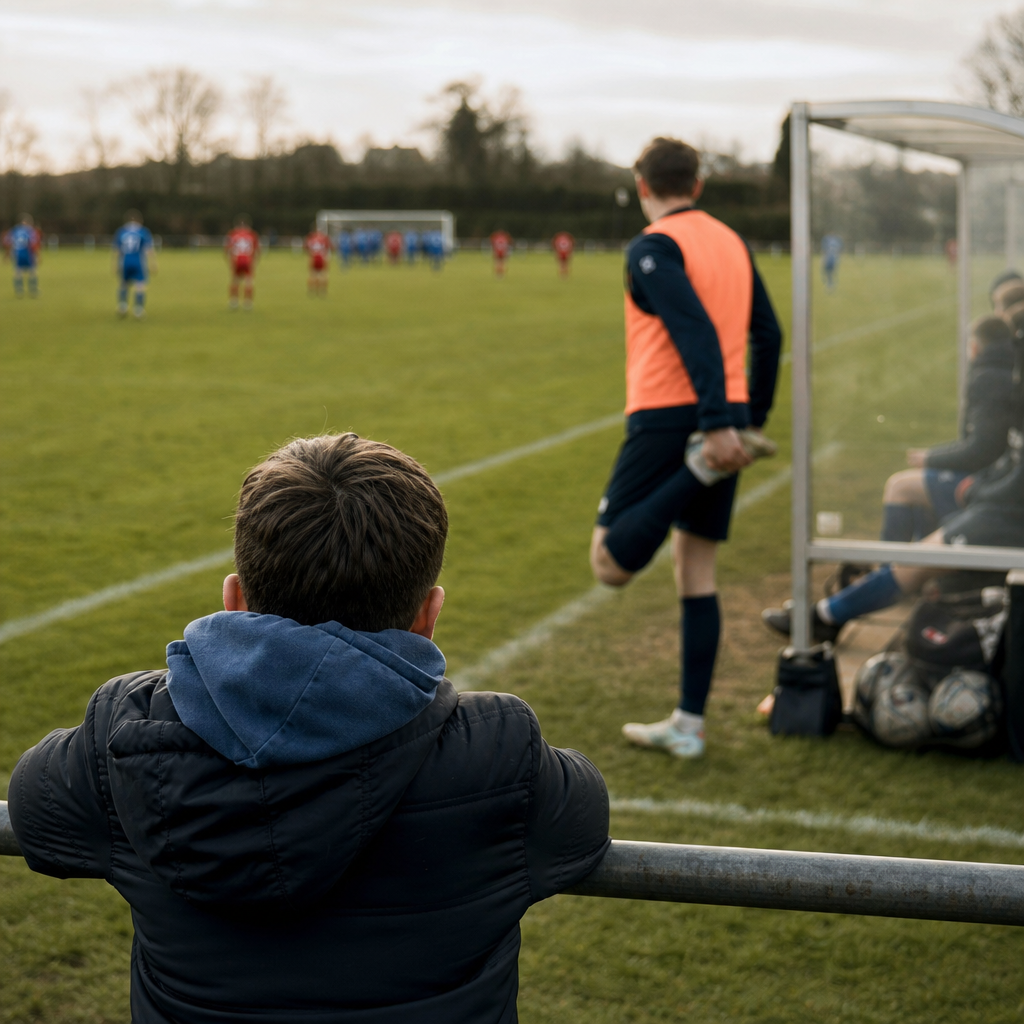
There's a moment at almost every grassroots football match where you glance over at the children in the crowd and notice they're watching completely the wrong thing. The ball is up at the far end in a goal-mouth scramble, and there's a small person five feet to your left who is intently watching the substitute stretching near the dugout. Or the left back jogging back into position. Or the goalkeeper doing absolutely nothing at all. Adults find this charming. A bit dim. A sign that they haven't quite grasped the object of the exercise.
Except it turns out that's exactly how the people who understand the game most deeply choose to watch it.
What the Ball Is Hiding From You
The ball is a trap. Not deliberately, but effectively. It's the brightest, most kinetic thing on the pitch and so your eyes chase it, and while they do, enormous amounts of information is happening elsewhere and you miss all of it. A striker making a run that will spring the defence in four seconds. A midfielder drifting into a pocket of space that nobody has filled. A winger standing still in a position that is either completely pointless or extraordinarily dangerous depending on what happens next.
Professional analysts, scouts, and coaches spend a significant portion of their time looking away from the ball. It's not a quirk or an affectation – it's the entire job. The formal study of off-ball movement, the positions that players take up before they receive the ball, is where most of modern tactical analysis actually lives. You can't understand why a team is effective, or why they concede, by watching the ball and nothing else. The ball only shows you what happened. The space and the bodies away from it show you what was always going to happen.
Children, with no framework for where they're supposed to look, accidentally land on this all the time.
The Fielder Who Isn't Fielding
Cricket is almost designed to expose this. Long-on is a fielding position that, during a quiet spell, involves standing in approximately the same spot for a very long time and waiting. Television cameras pan across fielders like this briefly and then return to the bowler's run-up, which is where the action is. But a fielder at long-on is reading the whole match simultaneously – adjusting their position by a few yards as the bowler changes their angle, watching the batter's grip, thinking about where the ball might go, communicating something in a look to the mid-on.
That's not nothing. That's the whole game, condensed into a person who isn't touching the ball.
The England cricket team's analysts sit in a box above the ground during international matches and watch video feeds that aren't centred on the ball at all. They're tracking the fielding captain's adjustments, the batting team's responses, the cumulative data of small decisions building into a picture of how this particular match is being won or lost.
The Goalkeeper With Nothing to Do
Football goalkeepers are rated, in part, on their positioning during phases where they have no chance of touching the ball. A goalkeeper who wanders to the edge of their box, or who creeps too deep, is revealing information to the strikers even in a quiet spell. The goalkeeper who stays in exactly the right place while someone else has the ball thirty yards away is doing something – it just looks, to anyone watching the ball, like nothing at all.
For more on this, have a look at *Finishing the Painting Right Now* – it's a lovely piece of thinking that connects to this idea, because it makes the point that watching something unfold is not a passive act. The audience completes the work.
That's a strange and useful thing to sit with during a slow sporting moment. The watcher is not waiting for the sport to happen. They are part of how it happens.
The More Sophisticated Read
There's an exercise used in coaching education where trainee coaches watch footage of a match with the ball digitally removed from the frame. It sounds mad. Within about two minutes, it becomes the only sensible way to watch. You see shape, you see communication, you see the gaps that a team is deliberately protecting or leaving open – the actual game underneath the game.
Children stumble into this because they get distracted by the person who looks interesting rather than the event that looks urgent. That's the unlearned instinct, and it turns out to be quite hard to get back once you've been trained out of it. The substitute on the touchline isn't a distraction. He might be the only person on that pitch who already knows what happens next.