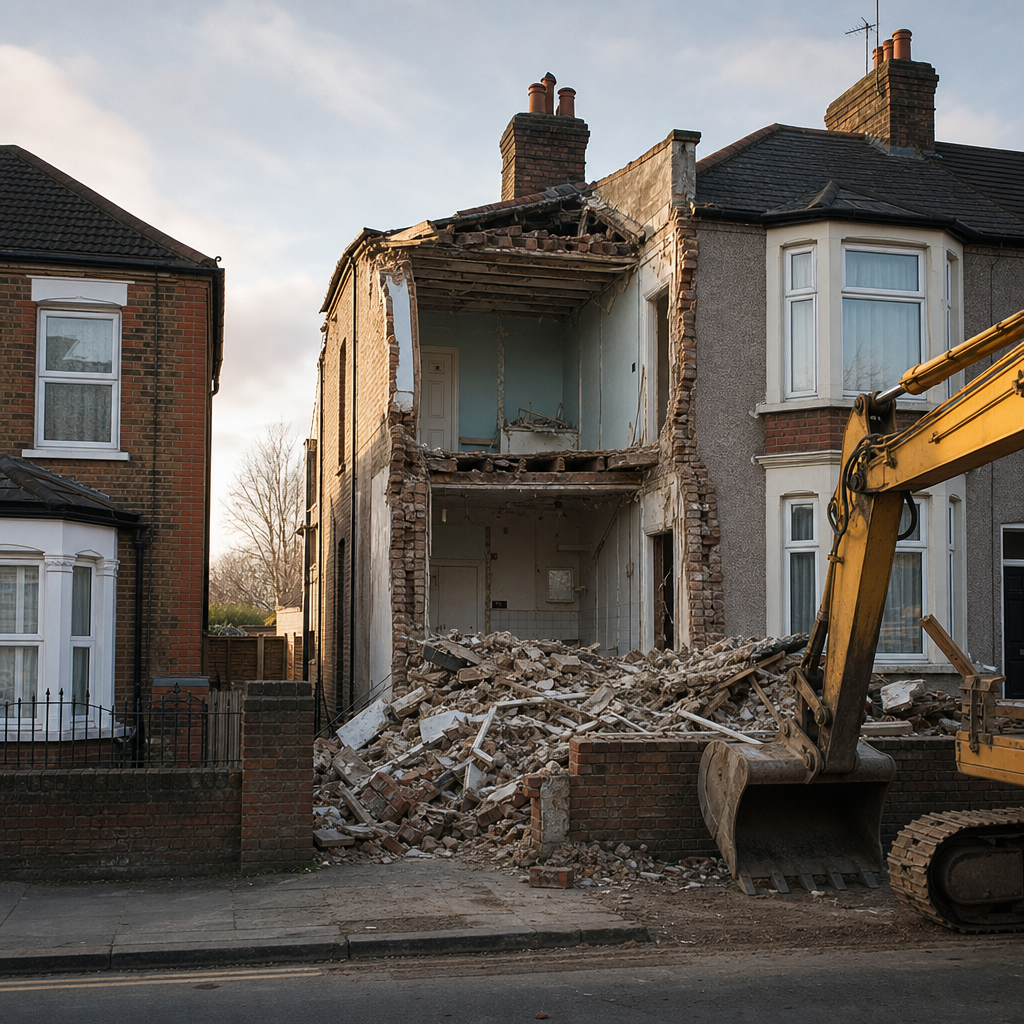
There's a rule buried in the VAT system that almost nobody knows about. It's been quietly rearranging British streets for decades. No planning committee voted for it. No design manifesto was published. A Chancellor just drew a line in the 1980s, and British builders have been stepping around it ever since.
The rule is this – knock a building down and put something new on the plot, and that work is zero-rated for VAT. No VAT. Nothing. Keep the existing building and improve it, and you pay 20%. Same street, same materials, same trades, same lorries pulling up at 7am – completely different tax treatment.
So the system that's supposed to be neutral has been whispering into builders' ears for forty years: demolish, don't renovate.
Why This Feels Odd Once You Clock It
Home improvement in Britain involves the rear extension of a Victorian terrace, the rotten bay window of a 1930s semi, the kitchen of a house last rethought in 1987. It involves the sash windows of a Georgian town house having been rattling since the Falkland War. These are not edge cases, these are the British housing stock and every single improvement to them carries a 20% tax premium that new-build work does not.
Meanwhile, the builder who converts a garage into a bedroom, repoints a crumbling chimney stack, or installs a proper dormer across the back is taxed on all of it. Someone who persuades a council to grant permission for demolition and a new-build gets the same job done with no VAT on the construction at all. The incentive structure is not subtle.
The Bit Where It Gets Weirder: Listed Buildings
For owners of listed buildings the rules split in ways that even experienced builders find genuinely confusing. For a long time alterations to listed buildings that were approved were zero-rated too, in common with new builds and not with ordinary old houses. This exemption was mostly removed in 2012 and listed building owners found themselves suddenly paying the full rate.
In practice, the more sensitive a building's restoration, the more expensive it will be relative to simply flattening and replacing. The very buildings that most demand careful, skilled, expensive restoration are the ones the tax system treats least generously. It's not a conspiracy, just a rule designed around one idea – encouraging new housing – running into a built environment designed around a completely different one: centuries of layering and adaptation.
For a broader piece on what renovation and conservation really involve at the level of individual decisions, The Painting That Was Finished Three Times (And Nobody Noticed) is worth a look.
Repair vs. Improvement: The Line That Nobody Can Find
Here is where it gets philosophically tricky. HMRC distinguishes between "repair" (keeping something in its existing state) and "improvement" (making it better than it was). Repairs, in some circumstances, can attract a reduced rate or qualify for exemptions. Improvements get the full 20%.
Sounds clean. Isn't. If your roof is leaking and you replace the tiles like-for-like, then this might count as repair. But if you swap them for a slightly better grade of tile then it might tip into improvement. Builders have to make a judgement call that a tax inspector might later disagree with. Some tradespeople just add the VAT to everything and let the homeowner argue about it. Others try to distinguish carefully and sometimes get it wrong. The boundary is genuinely contested, not just in disputes but in ordinary conversations on scaffolding.
The Aesthetic Consequences Nobody Planned For
For forty years or more Britain has been gently but persistently nudging the economics toward replacement over retention. New-build estates are not simply the result of planning decisions and housing demand. They are partly the result of a tax rule that made pulling things down more financially attractive than patching them up.
So long as a street is old and varied, each owner on it has been paying a 20% premium to keep it that way. The uniform new-build cul-de-sac down the road paid nothing extra at all.
Nobody sat down and decided that's what British streets should look like. The Chancellor's spreadsheet just had different numbers in different columns, and the bulldozers did the rest.