There is a particular kind of villain that the law struggles with: the one who is absolutely certain he is doing good. Not the poacher, not the developer with a digger. The man with the killing jar and the pressing frame – the tweed-jacketed fellow on his knees in a Devon meadow, lifting the last ghost orchid from the soil with enormous care and a look of genuine reverence on his face.
Britain came extremely close to losing several of its most extraordinary species not to industry or ignorance but to admiration. Passionate, learned, well-meaning admiration.
The Collectors Who Couldn't Stop Collecting
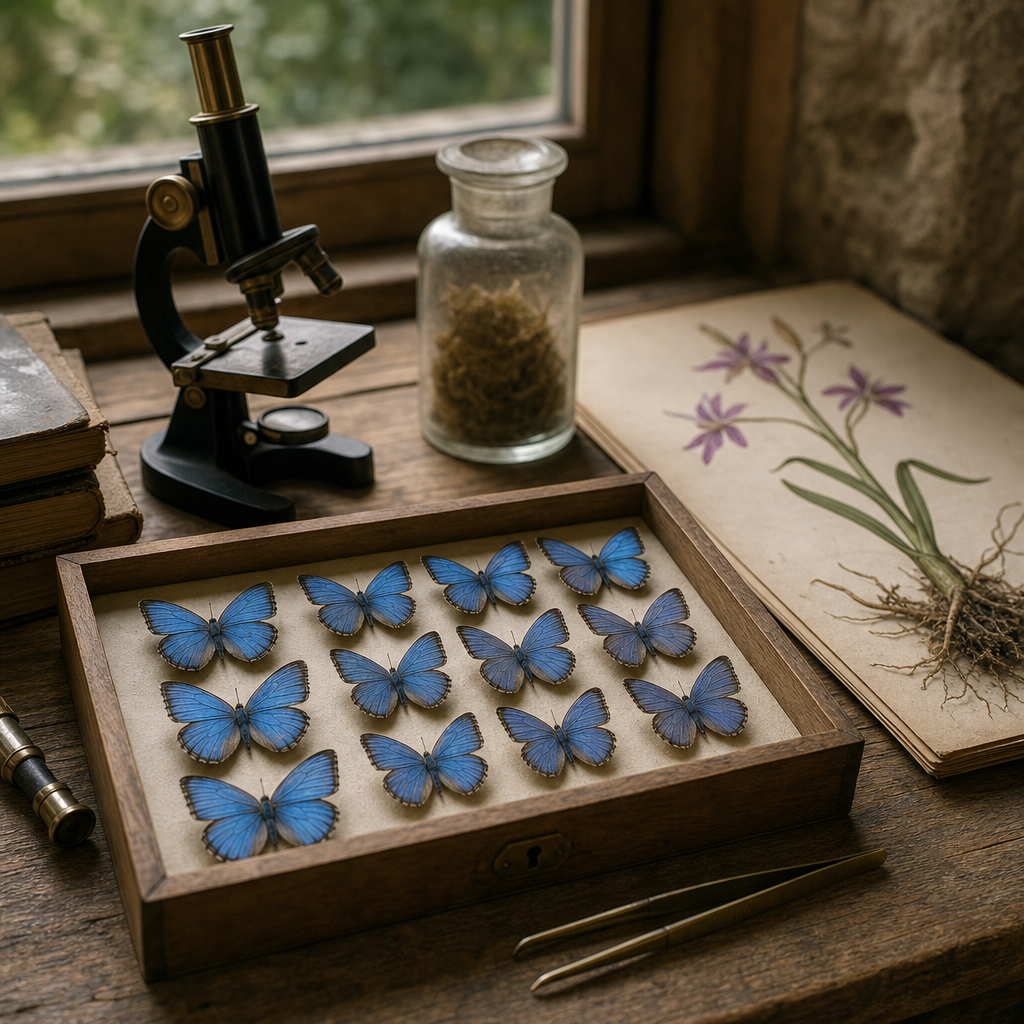
Victorian and Edwardian natural history had a peculiar logic: if a thing was rare and beautiful, the correct response was to acquire a specimen. Preferably several. The large blue butterfly, one of Britain's most extraordinary insects, was in serious trouble by the mid-twentieth century. Part of the reason? The people who cared most about it had spent the previous hundred years pinning it to boards. Egg collectors stripped nests so methodically that some species were functionally unable to replace themselves. Orchid hunters dug up plants that had taken decades to establish, reasoning that a plant dying in the wild was less honourable than a plant dying in a plant pot in Surrey.
These were not thoughtless people. They published journals, corresponded with each other in Latin, and were, by any Victorian measure, the educated champions of the natural world.
What the Law Had to Actually Say Out Loud
The Wildlife and Countryside Act 1981 had an unusual job: it had to protect nature from the people who loved it most. Which meant it had to get very specific about things that, in a saner world, would not need saying at all.
It became illegal to intentionally pick, uproot, or destroy any wild plant listed under the Act. Not "harm", not "damage in bulk" – intentionally pick. Taking wild bird eggs also became an offence, which sounds obvious until you realise egg collecting had been a respectable middle-class hobby within living memory. The Act had to name individual species because a general rule would not work on people who knew perfectly well which species they were after. For a wider look at what else the Victorian enthusiasm for beautiful and deadly things left behind, including the arsenic-soaked pigments used in art of the same era, When a Painting Could Kill You.
The Arsenic Thread
Here is where it gets strange. The same collector culture that nearly stripped Britain of its wild orchids was also, quite literally, poisoning its own archives. Natural history museums across the country are still finding that Victorian specimen collections – the very collections that documented species populations, that researchers used to understand what was once there, that informed the arguments for legal protection – were preserved with arsenic compounds. Beetle collections, bird skins, pressed plants: all dosed heavily with white arsenic to keep them intact.
The connection is not trivial. Some of the scientific baseline data behind the 1981 Act came from collections that are now hazardous to handle without gloves. The law that protected the living world was partly built on evidence from dead specimens that could give you arsenic poisoning if you touched them carelessly. There is something very Victorian about that.
The Large Blue's Second Chance
The large blue butterfly went extinct in Britain in 1979 – two years before the Act came into force, which is about as bleak a piece of timing as you can find in conservation history. It was reintroduced from Swedish stock in the 1980s and has since recovered on carefully managed grassland sites in Somerset and Gloucestershire. Its survival now depends on a very specific relationship with a single species of red ant, which means the grassland has to be grazed at precisely the right height, at precisely the right time of year.
The collectors who pursued it never needed to understand any of that. They just needed to know where it flew.
A Law With a Very British Embarrassment at Its Heart
The Wildlife and Countryside Act is not a dramatic piece of legislation. It does not read like something written in anger. But underneath the numbered clauses and the schedules of protected species, there is a faint blush of national embarrassment – the admission that Britain had to pass a law telling its most enthusiastic naturalists to please, for once, just look.