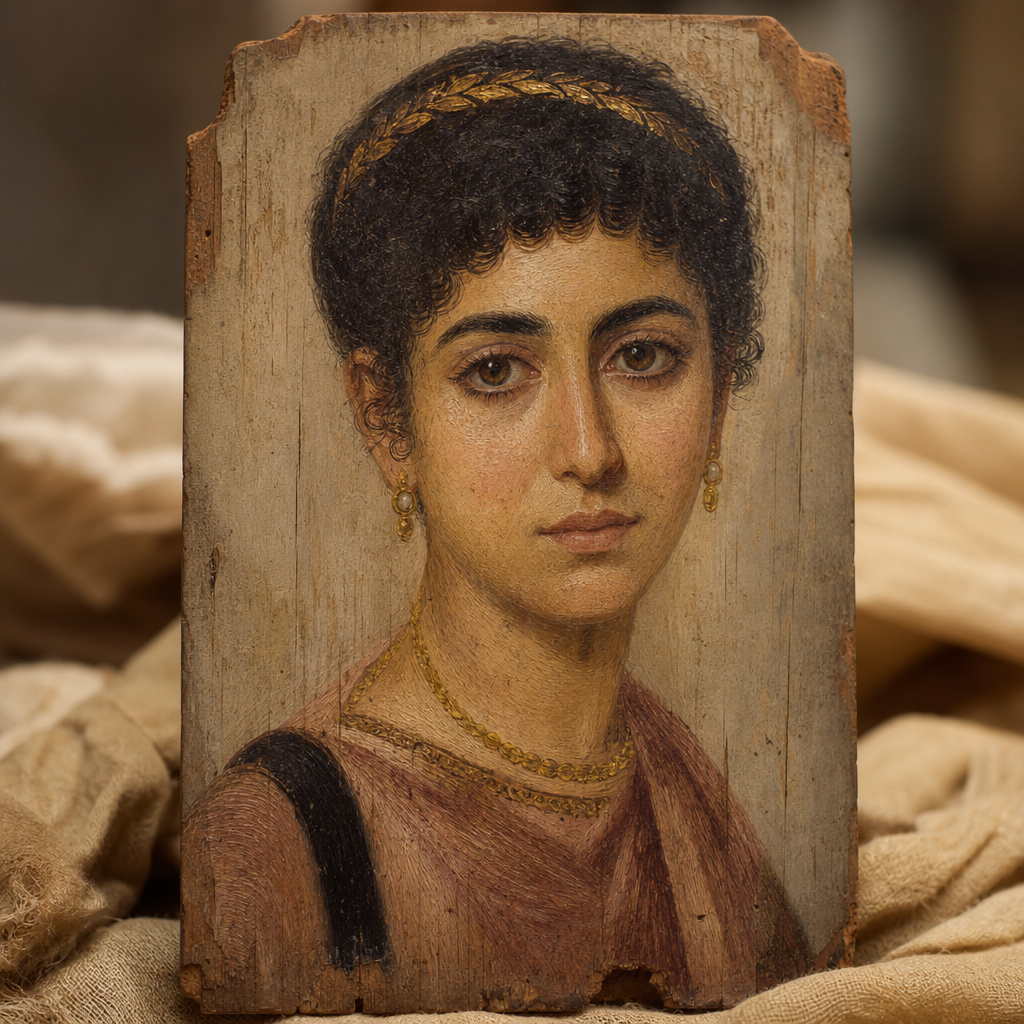
Somewhere in Roman-era Egypt, around the first or second century AD, a painter was melting beeswax over a flame. Into it they stirred powdered pigment – ochre, lead white, Egyptian blue – until the mixture was the consistency of thick paint. Then, working fast before it cooled and solidified, they pressed it onto a thin wooden panel and built up a face. A real face. Someone's neighbour, probably, or their merchant, their wife. The result looks so alive that when archaeologists pulled these portraits out of burial wrappings in the Fayum region of Egypt in the late nineteenth century, people genuinely didn't know what to make of them. The eyes follow you. The skin has warmth in it. They look like photographs taken before photography existed.
Wax Does Something Oil Simply Can't
The technique is called encaustic, from the Greek word for "burning in," and the secret is in what wax does to light. Oil paint sits more or less flat once it dries. Tempera – egg yolk mixed with pigment, which dominated European painting for centuries – goes slightly chalky. But wax? Wax is semi-transparent in a particular way. Light enters the surface, bounces around inside the layers, and comes back out from slightly different depths at once. That's the quality you're seeing when a Fayum portrait seems to glow rather than just reflect. The colour isn't sitting on the surface; it's alive somewhere underneath it.

It also, crucially, doesn't decay. Wax is hostile to mould, water, and air in a way that almost no other binder is – the Fayum portraits are two thousand years old and they have not faded. Many oil paintings from five hundred years ago have darkened, cracked, or shifted colour entirely as the linseed oil yellowed and the lead pigments did peculiar things. The wax just… held.
The Long Gap in the Middle
And yet encaustic essentially vanished after the fall of Rome. Medieval European painters moved to tempera and eventually to oil, and the technique wasn't seriously revived until the eighteenth century, when antiquarians trying to decode classical texts figured out roughly how it had worked. Even then, it remained a curiosity rather than a mainstream practice.
The reason is mostly practical. You need heat, and you are working in minutes, sometimes seconds, before the wax seizes – everything about the process demands speed and confidence together, which is an uncomfortable combination. Oil dries slowly and lets you think. Wax does not.
Modern encaustic artists – and there are quite a few of them now – tend to use electric heated palettes rather than open flames, which makes it somewhat less likely to go wrong.
The Same Problem, Different Materials
Almost every leap forward in art history turns out to be a new answer to the same question: how do you make colour stay? Fresco gets around the problem by pressing pigment into wet plaster as it sets – the colour becomes part of the wall. Oil solved certain things fresco couldn't. Acrylic solved other things oil couldn't. Encaustic, stubbornly, solved them all at once in the first century AD and was then forgotten for a thousand years.
The Fayum portraits have outlasted the names of the people in them, the city that commissioned them, and the empire that built the roads the pigments arrived on. That's wax for you.
Questions this raises
- Why have the Fayum portraits survived in such good condition?
- Where can you see Fayum portraits in Britain?
- How did painters work the wax before it cooled?
- Who were the people in these portraits?