Stand at the finish line of any major athletics meet today and you will see almost nothing. A laser. A transponder. A system that knows, to a thousandth of a second, who crossed the line first. The argument is over before it started.
It wasn't always like that. For most of the history of organised sport, the result of a race was, genuinely, a matter of opinion.
The Man With the Watch and the Reputation to Match
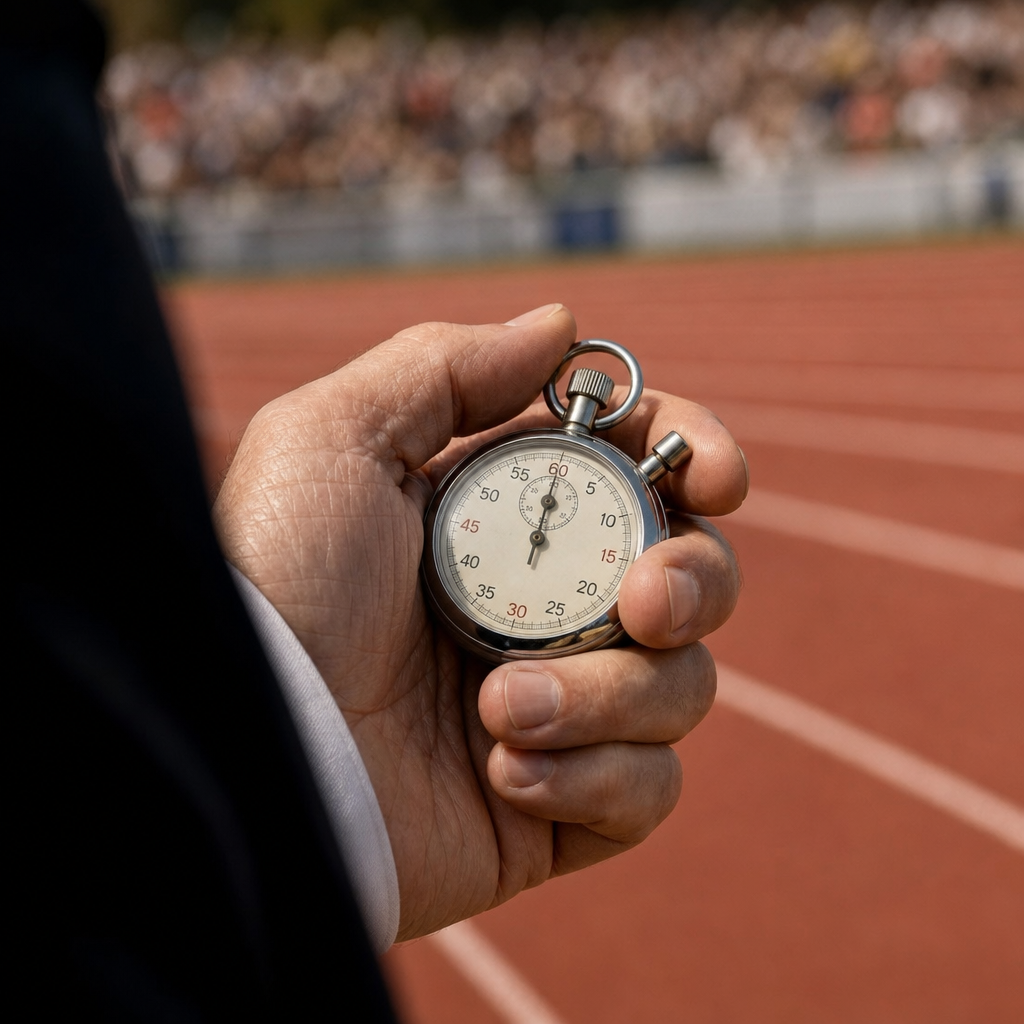
Before electronic timing arrived in the second half of the twentieth century, the finish line was staffed by human beings holding stopwatches and, crucially, a certain amount of social standing. Official timekeepers weren't certified through any formal body or examined on their reflexes. They were chosen the way a Victorian gentleman might be chosen for anything – by reputation, by club membership, by the fact that everyone more or less agreed they were the right sort.
At amateur athletics meetings, the timekeeper's word was the result. There was no second opinion unless you were important enough to request one, and even then, the second opinion was another man with another watch. If the two disagreed, they averaged them. If they really disagreed, they argued.
Reaction time was the hidden problem nobody liked to talk about. The gap between the starting pistol firing and a finger pressing the button on a handheld watch is somewhere in the region of 0.1 to 0.3 seconds. Different for every person. Different on every attempt. For short sprint races, that margin is not a rounding error. It is the entire result.
How a World Record Could Depend on Who Was Standing There
This is where it gets genuinely strange. World records in track athletics weren't just measured – they were ratified, by committees, by governing bodies, by people examining not just the time but the credentials of whoever held the watch. A time run at a well-attended meeting with reputable officials had a better chance of being accepted than the same time run in front of a smaller crowd with less prominent timekeepers.
Which means, in effect, that what counted as a world record was partly a social judgement. A fast runner at an obscure provincial meeting might run the fastest time in history and find it simply… not believed. Or not believed enough. The time would be noted, questioned, and quietly set aside.
The Photograph That Was Supposed to Settle Everything
The photo finish camera, introduced seriously into athletics from the late 1930s and 1940s, was meant to fix this. And in some ways it did. But early photo finish images were read by human eyes, and reading them wasn't straightforward – the technology produced a compressed, distorted image of the finish line at a single moment, and deciding whose torso broke the plane first still required a trained official to make a call. The photograph was evidence. It was not always proof.
What it did do, though, was produce a record. A visual document that could be examined, argued over, filed. This is the same instinct that put the finish-line photograph in a frame on someone's wall, or placed the trophy in a glass case, or hung the framed sporting print above the mantelpiece. The urge to capture the moment visually, to make it real and permanent and something you could point to, comes directly from the experience of watching a result dissolve into dispute. The Print Above Your Sofa Is a Very Recent Idea – and so, in sporting terms, was the idea of a result that couldn't be contested.
What the Stopwatch Left Behind
Electronic timing didn't arrive in Olympic athletics until the 1968 Mexico City Games, where fully automatic timing was used to measure to hundredths of a second. Before that, hand timing was still official. Several world records set before that point have since been quietly reassessed, because the times were hand-timed and hand timing carries that invisible margin of human error baked into it.
What's odd is that the hand-timing era, for all its imprecision, produced something rather interesting – a kind of humility around results. Everybody involved understood, at some level, that the number on the stopwatch was the best available approximation, not a fact. The timekeeper knew it. The athlete probably knew it. The committee ratifying the record certainly knew it.
Sport has been chasing certainty ever since. It gets closer every year. But that last thousandth of a second – the gap between the gun and the thumb, the eye and the line – that one belonged to the human being standing there, and no one ever really got it back.