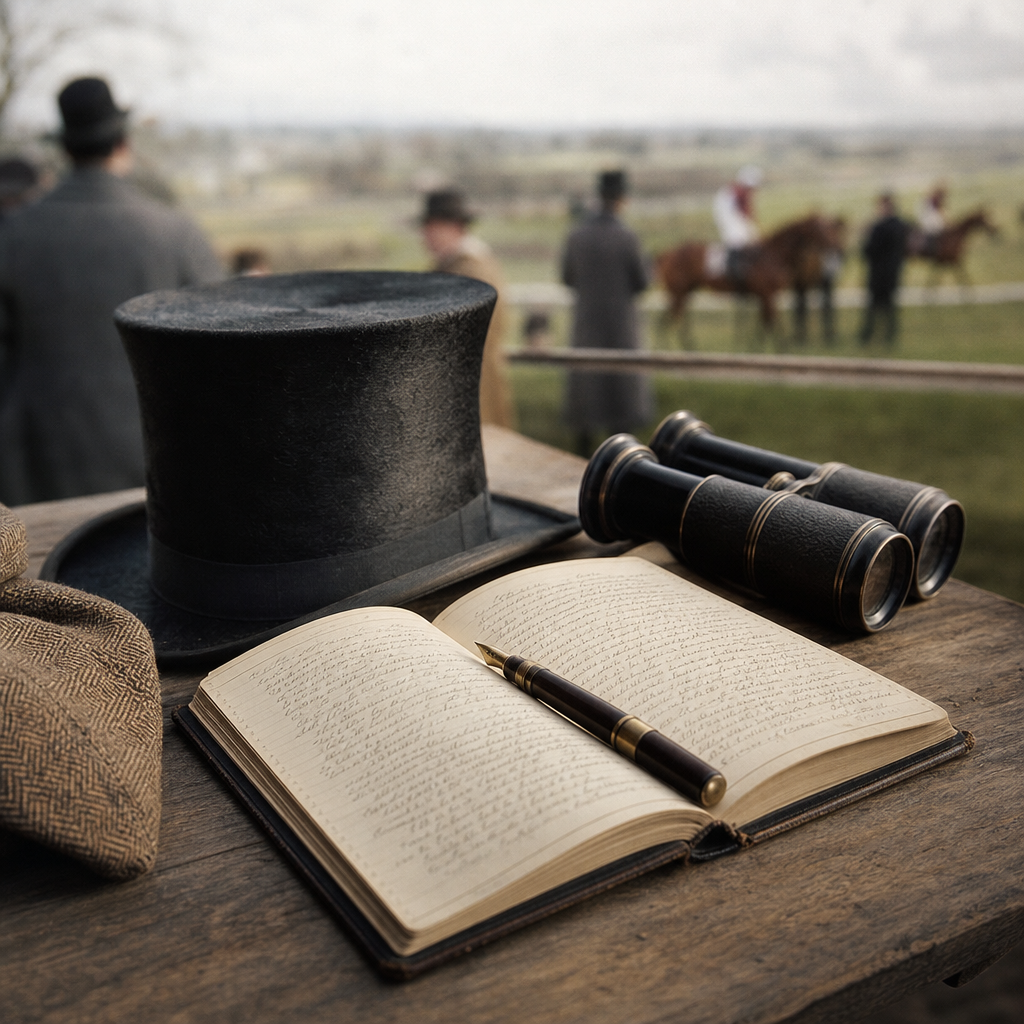
Imagine two men finish a horse race a nose apart, in a field, in 1780, with no camera and no photograph. One man's friends say his horse won. The other man's friends disagree – quite loudly, possibly with their fists. Who won? Whoever had the most credible witnesses. That was it. That was the entire system.
We tend to think the paraphernalia of organised sport – the referee, the linesmen, the timekeeper with the stopwatch, the scorer hunched over a leather-bound ledger – was invented to make games fair. But fairness wasn't really the problem. The problem was distance. How do you tell someone who wasn't there what happened?
The Witness Was the Technology
Before the telegraph, before the photograph, before any of it, sport had an audience of hundreds but a potential audience of thousands. Results travelled by word of mouth and by letter. A boxing match in 1820 might be described in a London newspaper two days later, read by someone in Edinburgh who hadn't been within two hundred miles of the thing. That reader had to trust it. And trust required a chain of credible people who could personally vouch for what they saw.
This is why so many early sporting bodies were obsessive about witnesses. When the Jockey Club formalised horse racing rules in the eighteenth century, the rules weren't just about what you could and couldn't do on a horse. They were about who was allowed to attest to what. A steward wasn't simply a kind of traffic warden. He was a named, socially recognised individual whose word carried legal weight, whose presence at the finish line meant the result could be reported somewhere as fact rather than rumour.
The referee, in this light, was a pre-electric verification technology. A living receipt.
The Scorecard as a Chain of Custody
Cricket stumbled onto this earlier than almost any other sport. The scored ledger – those lovely columns of dots and crosses that look faintly like a Victorian accountant's nightmare – wasn't invented because cricket needed it to run the game. The players knew what was happening. The ledger existed so the result could be communicated truthfully to anyone who asked, now or in fifty years' time.
You can see this impulse still twitching in modern sport. The ICC cricket scorecard, a Test match reported ball by ball, is not produced so the players can follow along. It exists so the record does. Every run, every dismissal, every extras wide – logged not because anyone in the ground needs reminding, but because the version of events for people who weren't there has to be exactly right and exactly permanent.
For more on how things that happened once get preserved beyond the moment they occurred, The Faces That Refused to Fade is worth a look. Paint and sport turned out to be solving the same stubborn problem from completely different directions.
The Rulebook Was Never Really Written for the Players
Here's the part that feels genuinely odd once you see it. The early rulebooks of most sports – the Football Association's laws of 1863, the Queensberry Rules for boxing in 1867, the lawn tennis rules drawn up at the Marylebone Cricket Club – were not primarily operating manuals for the people playing. Players at the time generally knew how to play. The rules were written for the reader at home, the newspaper editor, the man in Edinburgh, the future historian. They were a formal description of the game that could be cited, quoted, reproduced, believed.
A result achieved under recognised rules was a result that could travel. Without the rulebook, you just had a scrap in a field. With it, you had sport.
What the Referee Is Actually Doing
None of this means fairness didn't matter. Of course it did. But the machinery of officialdom that surrounds every modern match – the fourth official holding up the extra time board, the DRS review, the VAR monitor in its little tent – is the direct descendant of that original compulsion to make the result believable, verifiable, something a stranger could trust without having been there.
The referee isn't just stopping people from cheating. The referee is the guarantee that the result you read about on your phone tomorrow morning actually happened the way it says it did. Which is, when you think about it, an enormous job for someone in a black shirt and a whistle.