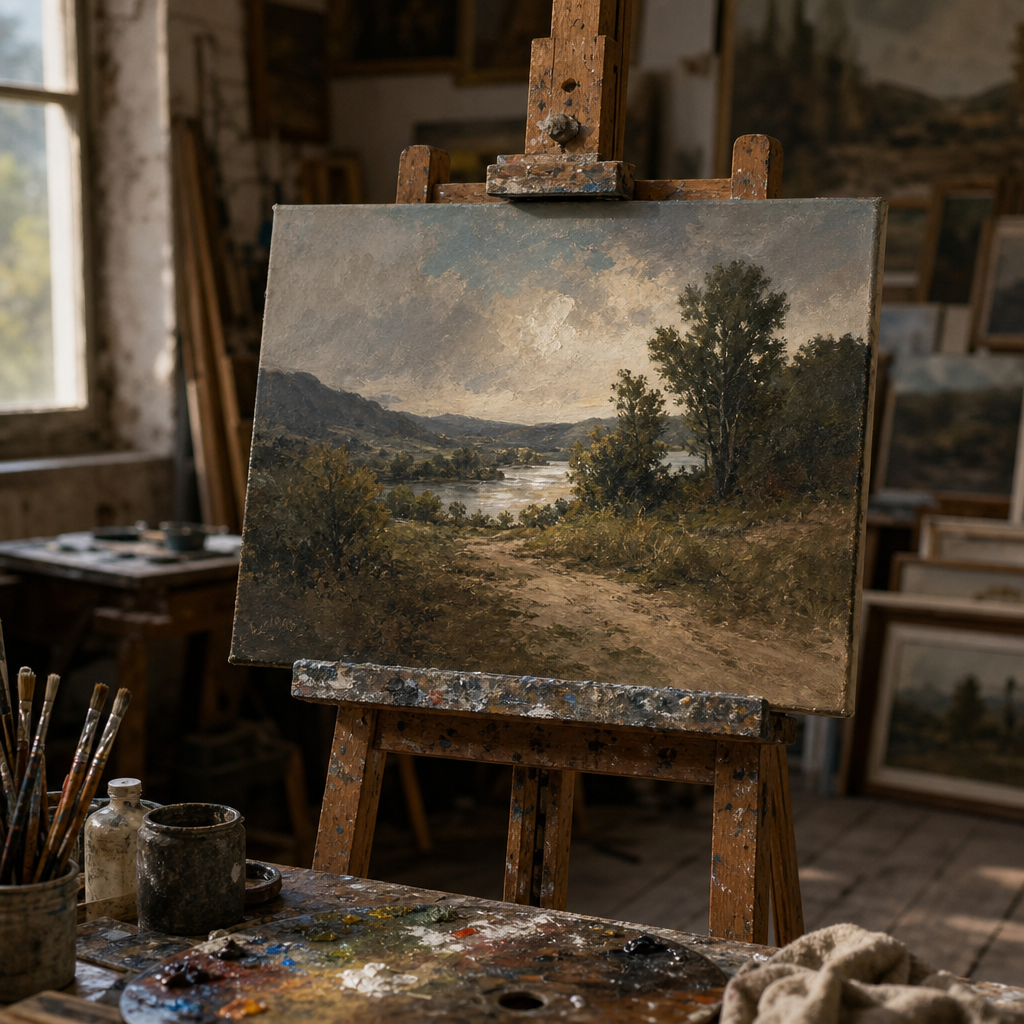
Look closely at the light on that famous pearl in a Vermeer painting. It is not just bright, it is wet. It looks like you could touch it. The light on the surface of the canvas is held, as if by a breath. Many painters worked to render this sort of light for centuries before Vermeer. Most of them failed, not because they weren’t talented enough, but because they lacked a particular substance: a dense, warm, slightly yellowish white. This paint was made by leaving strips of lead to corrode over vinegar fumes until the surface bloomed into a powdery crust. That crust was then scraped off, ground up and mixed into paint.
Lead white. Toxic, industrial, and almost entirely responsible for the way Western painting learned to show light.
Why Darkness Was the Easy Part
Shadow in Renaissance painting before lead white became widely available was straightforward enough to paint, as it meant using less pigment, or letting the ground show through. Light – the actual, convincing, glowing light landing on a face or a piece of silk – was essentially impossible to paint. You couldn't make a surface look as though it were emitting brightness, only suggest it.
The limitation wasn't skill. It was chemistry.
Painters needed a genuinely opaque white that could sit on top of a dark layer and actually cover it, rather than letting it bleed through. Also, the paint needed to dry fast, so that layers could be built up without waiting weeks between them. Lead white did both, better than anything else available.
The Trick Behind the Flesh
And once they had it, painters did something rather clever, first laying down a dark underpainting of umbers, ochres and blacks. Then they painted the raised parts of the composition with lead white – the cheekbones, the knuckles, the edge of the shoulder catching the light from the window. The dense, opaque lead white stayed bright while the dark underpainting stayed dark. For the first time, a painted face had volume.
Lead white is the hidden structure of almost every celebrated European painting between about 1400 and 1850. Rembrandt's portraits, Caravaggio's dramatic pools of candlelight, and Rubens' fleshy skin tones all rest on lead white doing its quiet, toxic work underneath.
How dangerous was lead white to the painters using it?
The problem was that lead white was killing people. Painters who worked with it daily absorbed it through their skin, and it accumulated in the body slowly and irreversibly. By the 19th century safer alternatives were being developed: zinc white first, then titanium white in the early 20th century.
Titanium white is brilliant, almost aggressively brilliant, and more opaque than lead white ever was. By any logical measure, it should be an improvement.
But something shifted when painters switched to it. Most gallery visitors register this without being able to name it. Lead white dries with a slight warmth, a creaminess, a give to it. Titanium white is cooler, stiffer, more insistent. Its highlights tend to feel hard-edged rather than luminous, more like something switched on than something glowing.
It's not that modern painting is worse. It just speaks differently. And the reason it speaks differently is a substance most people have never thought about once, quietly corroding in a jar, four centuries ago.
Questions this raises
- When was lead white banned for artists in Britain?
- Does titanium white behave differently on the canvas?
- Why can't lead white be reproduced safely today?