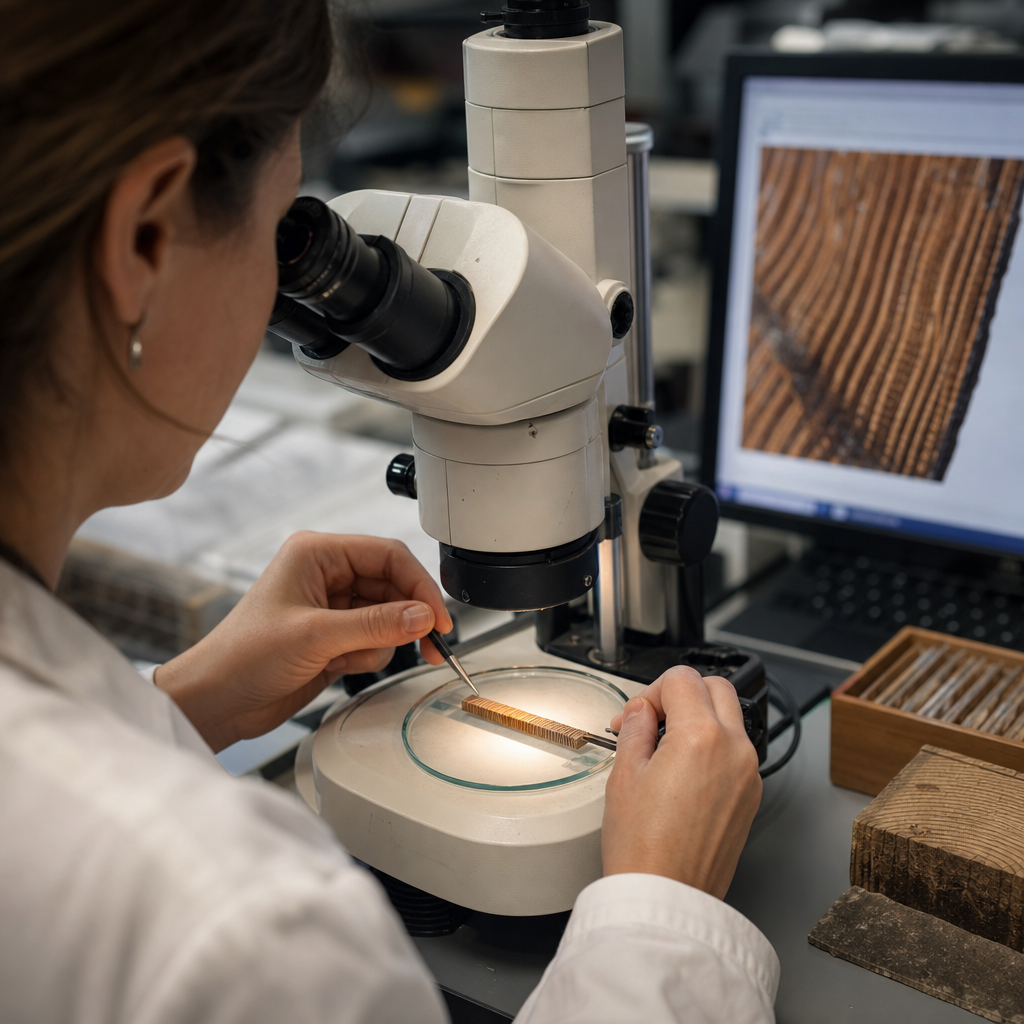
Somewhere in a temperature-controlled room in Switzerland, a technician is holding a sliver of wood thinner than your fingernail under a microscope and deciding, essentially, how rich someone is going to be. She's counting tree rings. If the rings say the oak panel couldn't have been cut until 1620, and the painting on top of it is supposed to be from 1510, then a collector somewhere has just had a very bad afternoon. Not because a dealer turned them away. Not because a critic wrote something sniffy. But because a dendrochronology unit sent a letter.
This is the actual power structure of the art world, and almost nobody talks about it.
The Moment Taste Stopped Mattering
For most of the history of the art trade, authenticity was decided by reputation. A scholar who had spent forty years looking at Flemish panel paintings would study your picture, tilt it towards the light, peer at the brushwork, and announce a verdict. The market trusted them because – what else were you going to do? Send the Rembrandt to a lab?
Then, gradually, you could. Infrared reflectography showed the underdrawing. X-ray fluorescence mapped the pigments. Carbon dating gave you a date range, and dendrochronology dated the wood itself. Suddenly the connoisseur with the forty years of squinting had a rival, and the rival had graphs.
The effect on prices was immediate and enormous. A certificate from the right authentication body doesn't just confirm that a painting is genuine. It unlocks the painting's full market value in a way that no amount of critical praise can. A work sitting in a regional auction house without paperwork will sell for a fraction of what the same work fetches six months later if a respected body issues a positive opinion. We're talking, in significant cases, the difference between £40,000 and £400,000 for the identical object.
The Certificate Has No Certificate
Here's the genuinely strange part. The organisations issuing these documents – some of them world-famous, operating under the names of long-dead artists' foundations, or under the branding of Swiss or German scientific institutes – are almost entirely unregulated. There is no body that certifies the certifiers, no agreed standard for what tests must be run or how they must be weighted. No agreed margin of error. And crucially, there is no liability. If an authentication body issues a positive opinion and it later turns out to be wrong, the buyer who paid £400,000 on the strength of that letter has very little legal recourse against the people who wrote it.
Different bodies reach different conclusions about the same painting. There are famous cases where one respected foundation has authenticated a work that another, equally respected body, has rejected. Both letters exist. Both are laminated. The market has to pick one. For authentication services and scientific analysis of artworks, costs can run from a few hundred pounds for basic pigment testing to well over £10,000 for a full multi-method examination – and none of it comes with a guarantee.
For a broader look at what physical evidence survives in paint long after the paperwork has crumbled, The Faces That Refused to Fade.
Why the Paint Knows More Than the Letter Does
The irony at the centre of all this is that the physical object is actually a far more reliable witness than any document ever could be. Paint layers don't lie about their age in the way that provenance records can be faked, sale catalogues can be forged, and letters of attribution can be fabricated. The chemistry is fixed. Lead white ground applied in 1650 will have a particular crystalline structure, and certain synthetic pigments simply didn't exist before specific dates. Prussian blue wasn't available until around 1704, so if you find it in a supposed 1680 landscape, something is wrong, regardless of what the paperwork says.
The laboratory's value, then, isn't in its certificate. It's in that raw data, the spectrometer readings, the tree ring counts, the pigment profiles. What the certificate does is translate that data into a market instrument. And that translation process, from evidence into price, is where the power sits.
The Most Influential People in the Room
Nobody elects them. Nobody audits them. They don't hang around at auction previews or write catalogue essays. But the quiet organisations deciding whether your painting passes or fails their criteria are, in practical terms, more influential over what a work of art is worth than any dealer, critic, or auction specialist alive. The art world spent centuries building a system based on expertise and taste, and then quietly handed the keys to a laboratory.